
And what a Benedictine approach adds
What a Christian leadership coach does
Good leadership coaching of any kind helps you see clearly, decide well and follow through. A Christian leadership coach does that work with one more question always in the room: what is God asking of you in this, and of this business? In practice, the work usually covers six things:
- Calling. Getting clear on why your business or organization exists beyond revenue, and who you are meant to serve.
- Decisions. Making hard calls from conviction instead of pressure, fear or the latest number.
- Character. Growing in the virtues that leadership demands: humility, courage, prudence, perseverance.
- Strategy. Building a plan you can execute, grounded in that calling rather than separate from it.
- People. Leading a team so people know they matter, not just what they produce.
- Rhythm. Practices of prayer, reflection and rest that keep the work from consuming the worker.
How it differs from executive coaching
Executive coaching usually treats faith as a private matter, if it comes up at all. Christian leadership coaching treats it as the foundation. Both care about performance. The difference is that a Christian coach will ask about your prayer life and your sense of calling with the same seriousness as your sales pipeline, because both shape how you lead.
That integration matters. Many Christian leaders live what I call the divided life: one person at church and another at work. The result is a quiet dissatisfaction that St. Benedict had a word for, grumbling. It shows up in leaders as exhaustion and in organizations as disengagement. Coaching that addresses only the business leaves the cause untouched.
“Faith shapes how you lead on Monday morning, not only how you worship on Sunday.”THE MONK GUY · INSIGHTS
What a Benedictine approach adds
Most Christian coaching draws on Scripture and on modern leadership practice. A Benedictine approach adds something else: the Rule of St. Benedict, a guide written around 530 AD for people who lived and worked together every day. Benedictine communities have used it for fifteen centuries to sustain shared life, good work and steady growth through plagues, wars and economic collapse.
Benedict did not write for hermits. He wrote for a working community, which is why his Rule translates so directly to a business, a nonprofit or a parish. In my work it shows up in five principles:
- Intention. Transform inwardly. Character and conversion of life come before strategy.
- Stability. Anchor firmly. A clear purpose and the discipline to stay with it.
- Community. Connect deeply. People are formed by the community they work in.
- Excellence. Improve relentlessly. Good work done with care, and with joy.
- Profound Hospitality. Deliver authentically. Every person is welcomed as Christ.
Three Benedictine practices also shape the coaching itself. Benedict’s Ladder of Humility gives leaders a clear path of interior growth. Ora et labora, prayer and work, treats them as one integrated life rather than competing demands. And instead of a list of goals, each leader writes a Rule of Life: a short, livable pattern for how they intend to live and lead.
Who benefits most
- Business owners and executives who are successful by every outside measure and hollow on the inside
- Leaders tired of keeping faith in one box and leadership in another
- Founders who want to build something that outlasts them and forms the people inside it
- Nonprofit and ministry leaders whose mission is clear but whose organization is worn out
What to look for in a Christian leadership coach
Whoever you choose, these questions will help you tell the difference between real integration and a business coach who happens to pray:
- Real business experience. Have they helped organizations grow, through good years and bad?
- A framework, not just encouragement. Can they explain how faith and strategy connect in practice?
- Validated tools. Do they use proven assessments, such as VIA Character Strengths or CliftonStrengths, alongside spiritual practice?
- Honesty about fit. Will they tell you “not yet” if this isn’t the right season?
- Respect for your tradition. Do they work with your faith as you live it, rather than asking you to adopt theirs?
How I work with leaders
My one-on-one coaching is the Integrated Leadership Journey: strategy and spiritual guidance in one engagement, built on the principles of Intention and Stability. It begins with a discernment conversation, moves through a strengths report and a strategic plan for your business, and ends with a Personal Rule of Life for you. Learn more about the Integrated Leadership Journey →
Common questions
Do I have to be Catholic?No. The Rule of St. Benedict is shared Christian heritage. I work with leaders across Christian traditions, and all are welcome.
Is this the same as spiritual direction?No. Spiritual guidance in coaching keeps your faith in the conversation about your leadership and your business. It complements formal spiritual direction rather than replacing it.
Will we still work on business results?Yes. Every engagement produces a strategic plan for your business. The difference is that the plan grows out of your calling instead of competing with it.
Begin with a conversation
Every engagement starts with a 45-minute discernment conversation: an honest look at where you are and whether this is the right season to work together.
Book a Discernment Call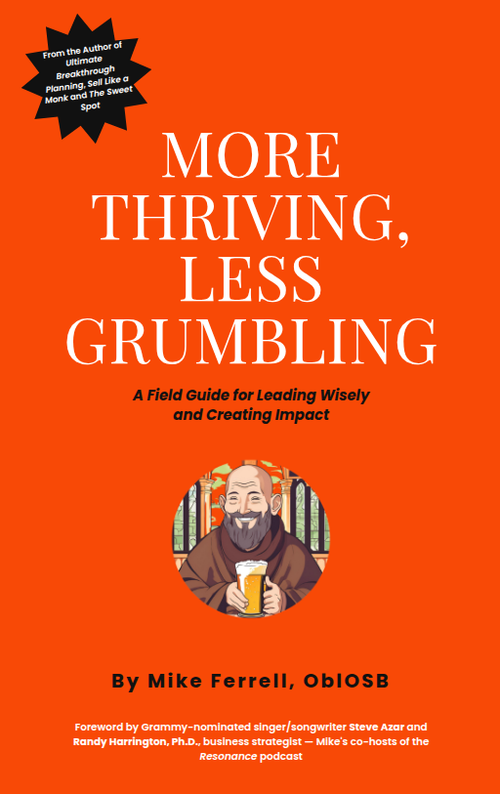
GO DEEPER WITH THE BOOK
More Thriving, Less Grumbling: A Field Guide for Leading Wisely and Creating Impact walks through all five Monk Principles, with a worksheet in every chapter. Buy it by Christmas, December 25, and I’ll send you the free Companion Workbook.
About the author. Mike Ferrell, The Monk Guy, is a Christian leadership coach applying the Rule of St. Benedict to business. A Benedictine Oblate, he has spent nearly four decades as a strategy and leadership coach across more than 70 industries, and he is the author of six books, including More Thriving, Less Grumbling.