
What grumbling is really telling you, and what St. Benedict told leaders to do about it
Grumbling is a symptom, not the problem
St. Benedict wrote his Rule for communities of people who had given their whole lives to seeking God. Even there, grumbling crept in, and he named it at least nine times in a short document. He did not treat it as a minor annoyance. He treated it as one of the most dangerous threats a community faces.
What made his approach unusual is that he didn’t stop at forbidding it. He required the abbot to find out what was causing it and deal with the cause. A fever is not the illness; it tells you there is one. Grumbling works the same way. The complaint itself is rarely the problem. What it points to usually is.
Benedict also drew a clear line between grumbling and genuine voice. He wanted the whole community consulted on important matters, because “the Lord often reveals what is better to the younger.” Honest feedback tries to build something. Grumbling is an undercurrent that wears the community down.
“Grumbling is a vital sign, the organizational equivalent of a fever.”THE MONK GUY · INSIGHTS
How grumbling spreads
Benedict saw grumbling as contagious, and it tends to move in the same order every time:
- Indifference. Small complaints about decisions people didn’t agree with, minor frustrations left unaddressed.
- Disdain. The complaints turn toward the organization and its leaders.
- Withdrawal. People do the minimum. They check out emotionally long before they leave physically.
- Sabotage. People begin to undermine the mission they once believed in.
Benedict had a name for monks who reached the end of that road: gyrovagues, wanderers who moved from monastery to monastery looking for something better and never committed to where they were. Today we call it quiet quitting, disengagement and turnover.
What it costs
Gallup’s State of the Global Workplace research finds that more than 70 percent of employees are disengaged or actively disengaged. Only three in ten bring their full energy and commitment to work. Organizations with disengaged teams see more absenteeism, more accidents, more errors, and lower productivity and profitability.
The human cost runs deeper. In Zach Mercurio’s research on mattering, 95 percent of people said feeling valued at work was important, yet 82 percent said they felt lonely at work. That gap between what people need and what organizations give them is where grumbling grows.
The four root causes
In more than three decades of working with leaders, I’ve seen the same four causes again and again. Each is a disconnect between how people are made and how we try to run our organizations.
- Scarcity thinking. Leaders fixate on what they lack: time, money, people, customers. Teams feel the fear. They hoard information, compete with each other and stop taking risks.
- Misalignment. The organization knows its targets but not its higher purpose. Leaders optimize for metrics and neglect meaning, and people do their jobs and search job boards on their lunch breaks.
- Exhaustion. Every success becomes the new baseline. There is no pause to celebrate, so people burn out on an endless run of targets that never seem to lead anywhere.
- Isolation. When people sense they are seen as resources rather than human beings, they stop offering ideas and stop going the extra mile. Disengaged people make others feel alone, and whole teams become islands.
Listen for the phrases. “We don’t have enough time.” “We don’t have enough money.” “We don’t have enough people.” “Leadership doesn’t understand.” “Nothing ever changes here.” Each one is a symptom of one of the four causes.
Six questions to diagnose your own organization
- Can I clearly articulate the vision and higher purpose of this organization?
- Can my people say why their work matters beyond the paycheck?
- Are we optimizing for metrics at the expense of meaning?
- Do people have a genuine voice in shaping our direction, or do they simply carry out what they’re told?
- Is there space in our culture to celebrate success before moving on to the next challenge?
- Do my people know they matter, not just for what they produce, but for who they are?
The first question is the one that makes most leaders uncomfortable. If the leader can’t connect the daily work to something larger than the numbers, nobody else in the building can either.
Start with your own grumbling
Benedictines practice statio, a deliberate pause to collect yourself before something important. Before you try to fix grumbling in your organization, take your own. Find a quiet place and sit with three questions:
- Where am I grumbling in my own heart? What dissatisfaction have I been carrying that I haven’t named?
- What is that grumbling telling me about what I truly value?
- If I’m honest, what am I actually optimizing for, and does it match what I say I value?
Leaders who take these questions seriously often find they have been chasing goals that don’t matter to them, measuring the wrong things, or losing touch with why they started leading in the first place. That is the right place to begin.
What thriving teams have instead
What thriving organizations have is simple to describe and hard to build: they put people and purpose first. The late Bob Chapman led Barry-Wehmiller on that premise, under the banner “Everybody Matters,” and grew the company steadily for decades while integrating more than ninety acquisitions. It isn’t people over profits. It’s people in harmony with profits. Get the human equation right and the business equation follows.
Working on it with help
My book More Thriving, Less Grumbling opens with this diagnosis and then walks through the five Monk Principles that answer it, with a Grumbling Self-Assessment and a worksheet in every chapter. If you want help applying it, the Integrated Leadership Journey works one-on-one with leaders, and Integrated Organization works with leadership teams. See both →
Common questions
Is all complaining grumbling?No. Benedict wanted every voice heard, including the newest. Feedback that tries to improve something is a gift. Grumbling is complaint that goes nowhere and wears people down.
Should I just tell people to stop grumbling?That treats the fever and ignores the illness. Ask what the grumbling is pointing to, fix that, and the grumbling usually fades on its own.
What if the grumbling is about me?Then it is the most useful information you have. Start with your own statio, ask one trusted person for honest feedback, and act on one thing you hear.
Begin with a conversation
Every engagement starts with a 45-minute discernment conversation: an honest look at where you are and whether this is the right season to work together.
Book a Discernment Call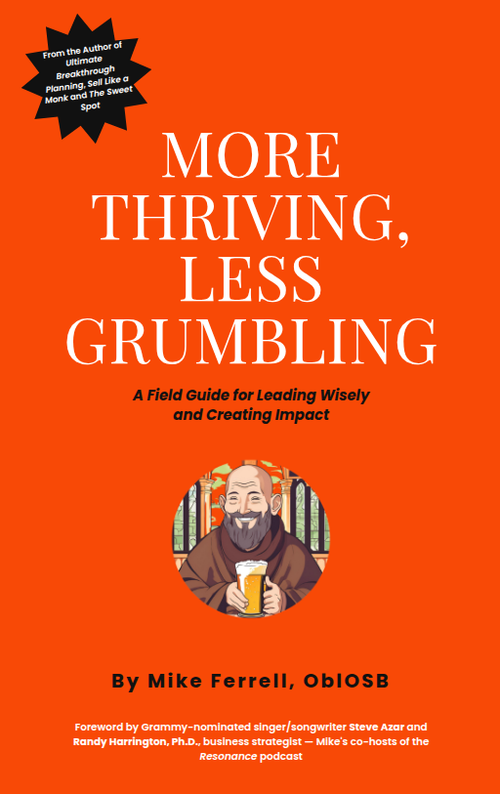
GO DEEPER WITH THE BOOK
More Thriving, Less Grumbling: A Field Guide for Leading Wisely and Creating Impact walks through all five Monk Principles, with a worksheet in every chapter. Buy it by Christmas, December 25, and I’ll send you the free Companion Workbook.
About the author. Mike Ferrell, The Monk Guy, is a Christian leadership coach applying the Rule of St. Benedict to business. A Benedictine Oblate, he has spent nearly four decades as a strategy and leadership coach across more than 70 industries, and he is the author of six books, including More Thriving, Less Grumbling.