
Why it starts with your own people, and how to tell whether it survives without you in the room
Where it comes from
Chapter 53 of the Rule of St. Benedict contains one of the most quietly radical sentences in the whole document: “All guests who present themselves are to be welcomed as Christ.” Read it carefully, because it isn’t a service standard. It’s a claim about who is actually standing in front of you.
Benedict applies the same seriousness inside the community. In Chapter 36 he writes that care of the sick must rank above and before every other concern. That is not a general call to be kind. It’s a ranked priority, given to people who had nothing to offer back.
Hospitality is not customer service
Will Guidara, who helped make Eleven Madison Park one of the most celebrated restaurants in the world, puts it simply: service is black and white, hospitality is color. A correct order delivered promptly is service. Overhearing that a table of out-of-town guests never got a real New York street hot dog, then buying one from a cart and serving it to them as a course, is hospitality. No policy manual would have told anyone to do that.
My friend and Resonance co-host Steve Azar does something similar every time a Viking river cruise stops in his hometown of Greenville, Mississippi. Before the first note of his show, he stands outside greeting every guest as they step off the bus, as if he has been waiting all day for them specifically. By the time they take their seats, they have already experienced Profound Hospitality, and the show hasn’t started.
The difference is presence. People can feel the difference between being seen and being processed efficiently, even when they can’t say what tipped them off.
It starts with your own people
Most leaders read “hospitality” and think only of customers. Benedict doesn’t. Danny Meyer, who built one of the most respected hospitality companies in the country, puts employees first, guests second, and investors last, because you can’t deliver genuine hospitality outward from a team that isn’t treated well on the inside.
Hospitality that shows up for paying guests while the team gets whatever attention is left over isn’t Profound Hospitality. It’s customer service with better branding.
“Detail is where love becomes visible in practical form.”THE MONK GUY · INSIGHTS
The four elements
In the book I score any client, customer or employee experience on four elements together:
- Welcome. The first genuine contact.
- Authenticity and Presence. Whether the attention is real or performed.
- Detail. The small, specific things that prove care rather than claim it.
- Surprise and Delight. The unscripted moment that turns adequate service into something worth telling someone about.
An experience can score well on three and still be forgettable, because the fourth is usually the one people remember. Research on memory points the same way: we remember the most intense moment and the ending, not the average. Yet many organizations pour their effort into the middle of the customer journey and almost none into the beginning and the end.
The real test: does it survive without you?
My friends Riccardo and Marybeth Tarabelsi run two Italian restaurants, a wine bar, a jazz club and a catering business in Sioux Falls. Their tagline is “enter as friends, leave as family,” and the feeling is the same in every one of their places, on a slow Tuesday or a packed Saturday, whether or not anyone from the family is working that night. Their staff remember the anniversary, the favorite table and the child finally old enough to order off the adult menu.
Plenty of owners can make a room feel warm while they are standing in it. Far fewer have built something that holds when they take a night off. Hospitality that depends on the founder being present is a very good performance with one irreplaceable lead actor, and lead actors eventually go on vacation.
Disney understood this at scale. Even the backstage tunnels no paying guest will ever see are held to a high standard, and the story goes that trash cans were placed about thirty steps apart, because that is how far a guest would carry a wrapper before dropping it. Your real standard is whatever you keep when nobody is watching.
Three practices to start this week
- The Welcome Assessment. Look at the first three minutes of three moments through the other person’s eyes: a new client’s first contact, a customer’s arrival and a new employee’s first day. Where has performance replaced presence?
- The Presence Practice. Before your next important conversation, take fifteen seconds to set down what you were doing. Put the phone out of sight, ask one real question, and wait for the whole answer.
- One detail. Pick one specific human detail, not a policy or a training program, that would create a memorable moment for a client or an employee. Put it in place this month, then check whether it still happens on a day you aren’t there.
Building it into your organization
Integrated Organization works with leadership teams on Community, Excellence and Profound Hospitality, including mapping a full client or employee journey against the four elements and building the details that last. Learn more →
Common questions
Does this apply if my business isn’t customer-facing?Yes. Every organization serves someone, and every organization has its own people. Benedict gave the sick brother the same care he gave the stranger at the gate.
Isn’t this just good customer service?No. Service is getting the transaction right. Profound Hospitality is presence and detail that make a person feel seen, and it has to hold for your team as well as your customers.
Do I have to be religious to practice it?The practices work in any business. For a Christian leader, Benedict’s reason gives them a deeper root: the person in front of you is to be received as Christ.
Begin with a conversation
Every engagement starts with a 45-minute discernment conversation: an honest look at where you are and whether this is the right season to work together.
Book a Discernment Call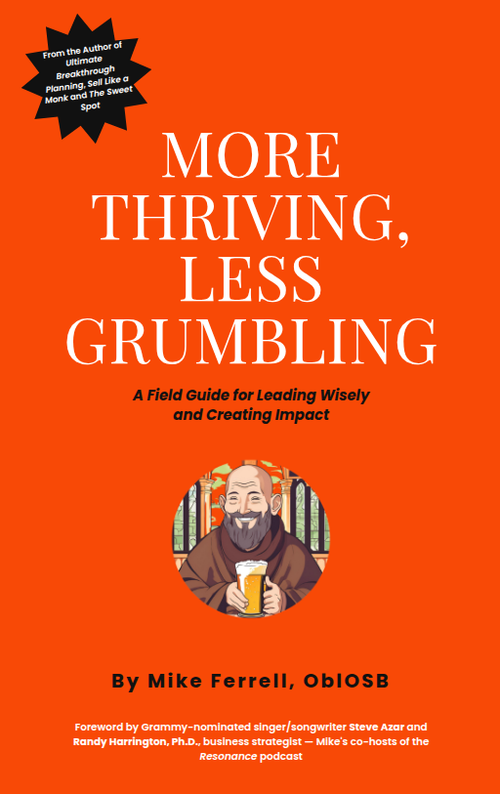
GO DEEPER WITH THE BOOK
More Thriving, Less Grumbling: A Field Guide for Leading Wisely and Creating Impact walks through all five Monk Principles, with a worksheet in every chapter. Buy it by Christmas, December 25, and I’ll send you the free Companion Workbook.
About the author. Mike Ferrell, The Monk Guy, is a Christian leadership coach applying the Rule of St. Benedict to business. A Benedictine Oblate, he has spent nearly four decades as a strategy and leadership coach across more than 70 industries, and he is the author of six books, including More Thriving, Less Grumbling.